Why cities and area marketing need to become "answer ready"
People increasingly ask an AI assistant directly instead of browsing a page of search results. If your destination's information isn't structured and machine-readable, that assistant either skips you — or, worse, makes something up.
From search results to straight answers
For twenty years, being findable meant ranking on a page of blue links. That's changing fast. A growing share of questions about places — "what's a good rainy-day activity near the harbour", "is this museum open on Mondays", "plan me a walking route past the old church" — now go straight to an AI assistant, a voice assistant, or an AI-generated overview at the top of a search page. The person never sees a list of websites to click through. They see one answer.
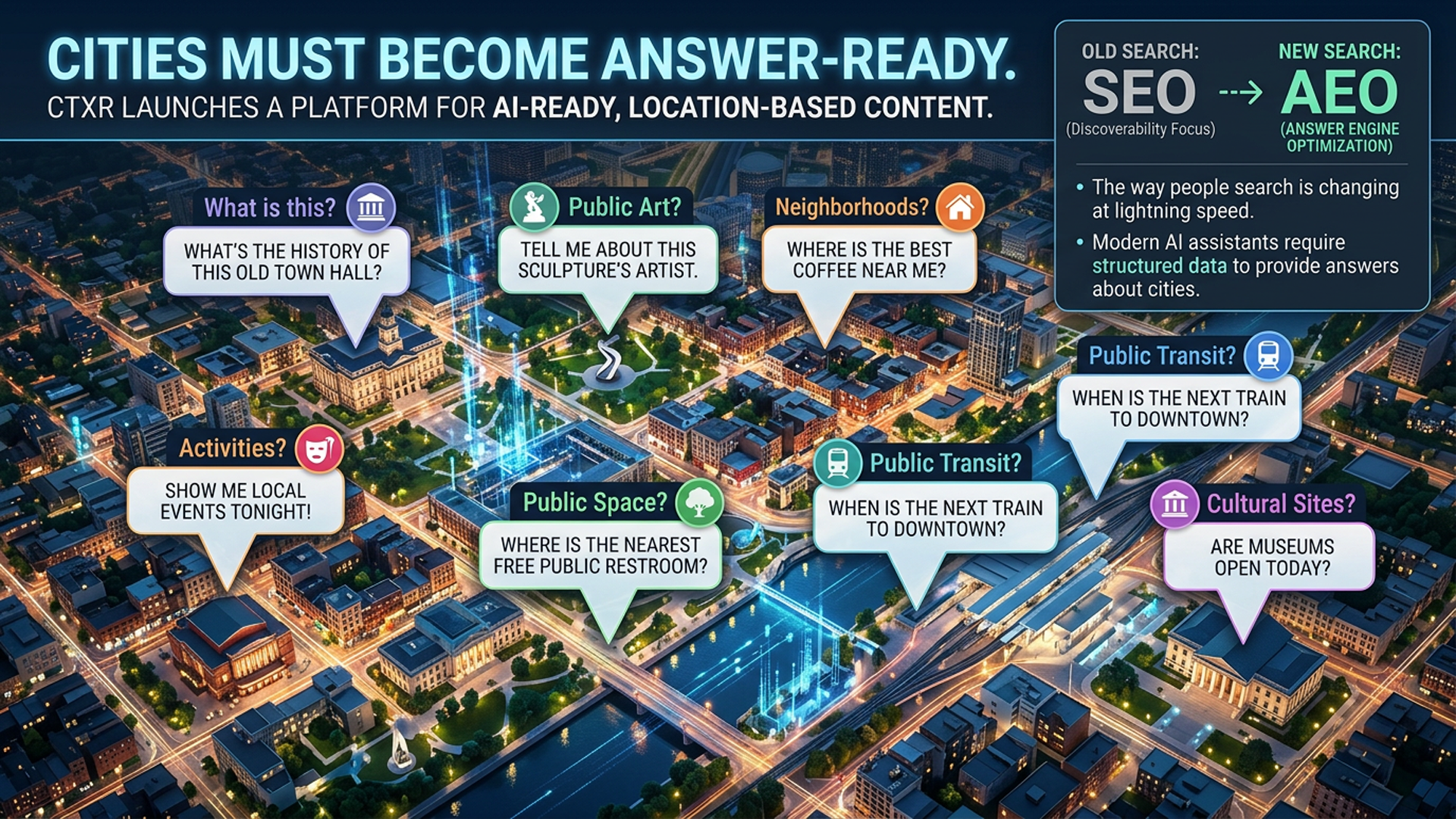
What happens when your destination isn't structured
An AI assistant can only answer well with what it can actually read and trust. If a city's or attraction's information lives in a PDF brochure, a slide deck, or a page of loosely formatted prose, an assistant has a hard time extracting reliable facts from it — opening hours, exact location, what makes this route different from the next one. Two things tend to happen: the destination gets left out of the answer entirely, in favour of a competitor whose content is easier to parse, or the assistant fills the gaps itself and gets a detail wrong. Neither is a good look, and neither is something a marketing team finds out about until a visitor mentions it.
What "answer ready" looks like in practice
Being answer ready means your content exists as structured, verifiable facts rather than free text buried in a document — the same principle behind GEO (Generative Engine Optimization), which we lean on across this platform. Concretely: every point of interest, route, and event is captured as its own record with a Schema.org type, consistent fields, and a canonical source of truth. That's what makes it possible for a search engine or an AI assistant to quote it correctly, attribute it to you, and keep it up to date automatically when something changes.
This is the model CTXR is built on: locations aren't paragraphs on a page, they're structured Points of Interest, routes and TouristTrips that both people and AI agents can read. Cities and area marketing organisations that get this in place now aren't just improving their website — they're making sure they're still part of the conversation once that conversation moves to an assistant.
Curious what "answer ready" would look like for your city or destination? See how CTXR structures location data, or try the free Sandbox.