AX: why Agentic Experiences are the next big thing after UX
First came the command line, then the graphical interface, then touch, then voice. Each shift moved us a little further from having to know how a system works, and a little closer to simply saying what we want. Agentic Experience — AX — is the next step: an AI agent that doesn't just answer, but acts on your behalf.
Every interface shift raised the same question
When the GUI replaced the command line, the question became "can people find the button." When touch replaced the mouse, it became "does this work with a thumb." When voice assistants arrived, it became "can this be understood without a screen at all." Each time, the discipline of UX and UI absorbed the shift and figured out the new rules. We're at the start of the next one — and it doesn't ask whether the interface is usable. It asks whether an AI agent can act on it correctly.
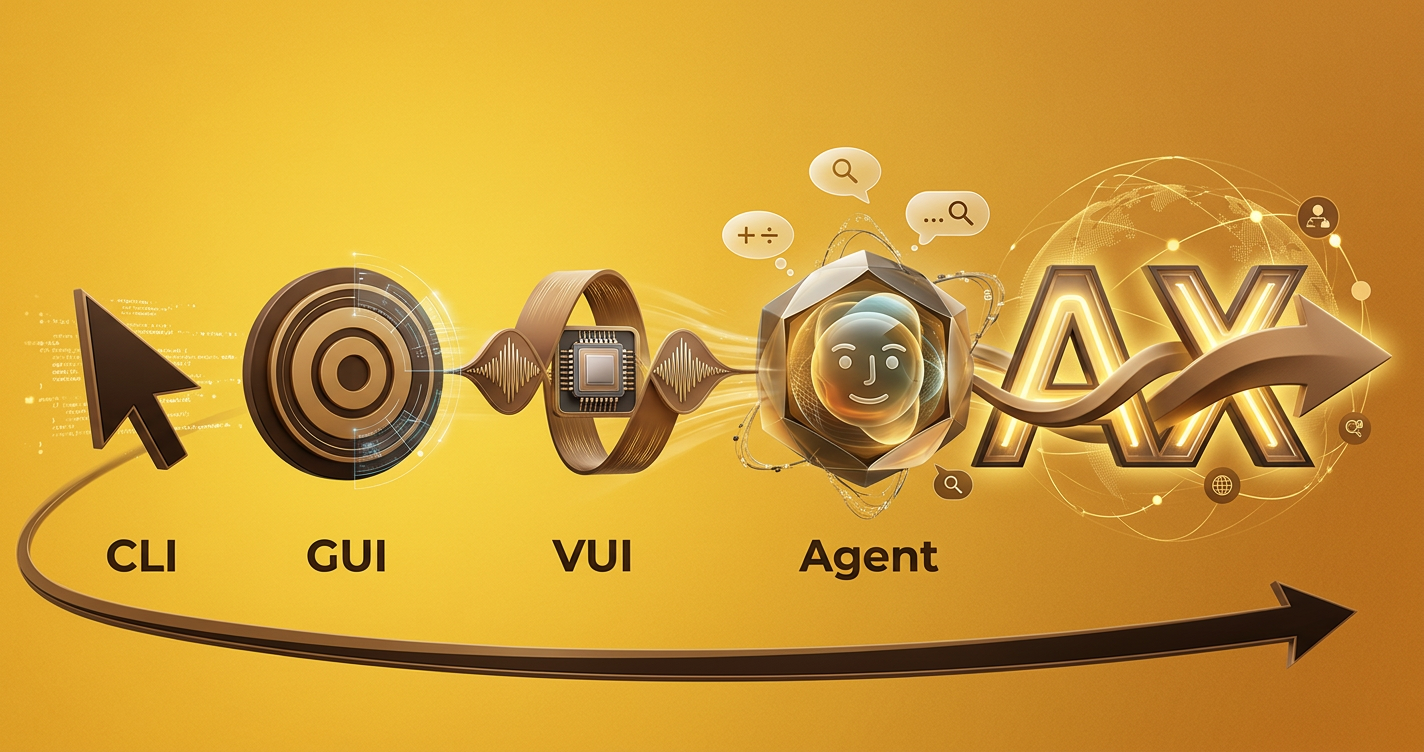
What "agentic" actually changes
An agent isn't a chatbot that answers a question and stops. It's software that can carry out a multi-step task on your behalf — plan a trip, compare four options, fill in a form correctly, or manage a website — by reading what's there, reasoning about it, and taking the next action. For the people using your platform, that means fewer clicks through menus and forms, and more simply describing what they want. For the people who own the platform, it means the same shift applies to the admin side: instead of learning where a setting lives in a dashboard, you describe the change and the agent makes it — exactly the shift we cover on our Services page, where CTXR itself can be managed by an AI agent instead of a traditional form-based backend.
Designing for AX means designing for both audiences
Agentic Experience isn't a replacement for UX and UI — good design is still what makes a product trustworthy and pleasant to use directly. AX sits alongside it, and asks a different question: can an AI agent perceive your content correctly, reason about it without guessing, and act on it safely — whether that agent is helping a visitor plan a route, or helping an owner update one? That only works if the underlying content is structured rather than buried in prose, which is exactly the foundation this platform is built on, and the same principle behind becoming "answer ready" for search and AI assistants in the first place.
The platforms that treat this as a real design discipline now — not an afterthought bolted on later — are the ones that will feel effortless once agentic interaction becomes the default, rather than the novelty.
Wait for an agency, or just do it yourself?
Ask yourself honestly: would you rather have direct control over your own site, or go through an external agency or developer who — if you're lucky — finds time for it in a few months, followed by an invoice for something that should have taken minutes? Agentic Experience makes that choice concrete: instead of requesting a change and waiting for it, you simply describe what you want changed, and an AI agent carries it out right away — exactly how this platform already works.
Why this is safer too
That's not just faster, it's safer too. A traditional CMS like WordPress relies on a database, an extensive plugin ecosystem, and a publicly accessible admin panel — all well-known attack vectors that have been responsible for the vast majority of hacked websites for years. CTXR doesn't carry those vulnerabilities: content lives as plain, version-controlled JSON files, with no database and no plugins to exploit.
Why this is more findable too
There's a third benefit too, and it's about findability. An agent can only work well with content that's structured — so agentic content management enforces that structure by default. Every opening hour, location, or price sits as its own unambiguous field, not buried in a paragraph. And that's exactly what AI assistants and answer engines need to cite your content correctly, instead of skipping you or making something up — the same principle we cover on our page about becoming "answer ready". Findability (AEO) then isn't a separate effort anymore, it's a direct consequence of how the data is already structured.
The benefits at a glance
In short, an interface shift is on its way: AI agents that don't just answer, but act on the user's behalf. Agentic Experience is emerging as a new design discipline alongside UX/UI, with speed, security and findability as concrete benefits.
- Speed and self-sufficiency — make changes yourself, right away, no waiting on an external agency or developer
- Low barrier to entry — plain language is enough, no technical knowledge required
- Smaller attack surface — no database or plugin ecosystem like a traditional CMS carries
- Better findability — structured data is easier for AI assistants and answer engines to cite correctly
- Future-proof — prepares an organisation for a shift that's just as inevitable as earlier interface revolutions
Things to keep in mind
- CTXR already has a preview step built in — every change an agent makes lands in a draft layer first; it only goes live once you publish it yourself. There's no separate preview step to build, it's already part of the platform
- Expect a bit of an adjustment — "agentic" as a design discipline is a new way of working, so experiment step by step
- Get your structure in order first — if your content is already well-structured, that's a major advantage. Bring poorly structured content (like most WordPress sites) up to standard first
- Permissions are already handled at CTXR too — access runs through keys with precisely scoped rights per person or agent (write but not publish, for example). Decide in advance which rights belong with which role
- Plan time for the switch — converting an existing site to an agentic-friendly structure takes some initial time and effort, but you make that back through having far more direct control over the content
Curious what agent-managed content looks like in practice? See the AI CMS section on our Services page.